AI portfolio / Case study
Fact-checking a fast-moving AI tool, one concept at a time
There were too many Claude Code videos to keep up with, and many repeated each other. I took one popular explainer, checked all 27 of its concepts against Anthropic's documentation, and turned the result into a short, quick-to-read field guide for people new to Claude Code.
- Role
- Solo: direction, fact-checking, editing
- Audience
- Myself, and anyone new to Claude Code
- Built with
- Claude, Python, Vercel
- Build time
- 1 to 2 hours over a few iterations; checked against the docs in September 2026
- 27concepts from the video, each checked against the official docs
- 24had changed or grown since the video was made
- 4were now misleading and needed a correction
- +8new topics the video couldn't cover, for 35 in total
Problem
Too many videos, too much repetition, too little time
Learning Claude Code meant wading through a stream of videos, many covering the same ground, with more being published than anyone could watch. I wanted something easy to reach and quick to read: a starting point, not another hour of video.
There was a second problem too. The tool changes faster than the videos, so a viewer can't tell which advice still holds, which commands were renamed, or which features are presented as ready but are actually experimental.
The insight
I didn't need more content about Claude Code. I needed one short starting point I could trust, with every claim traceable to its source.
So every topic says whether the video's advice still holds, and links to both the official documentation and the original video. The creators whose work it builds on get the credit.
How it was built
Claude did the research, I checked it against the sources
-
Research
I had Claude do the legwork: pull every concept out of the video, research each one against Anthropic's documentation, and draft a plain-English explanation with real-life use cases.
-
Check and credit
I checked the content against the sources, and made the sources part of every page. The guide shouldn't take credit for other people's work.
-
Label each topic
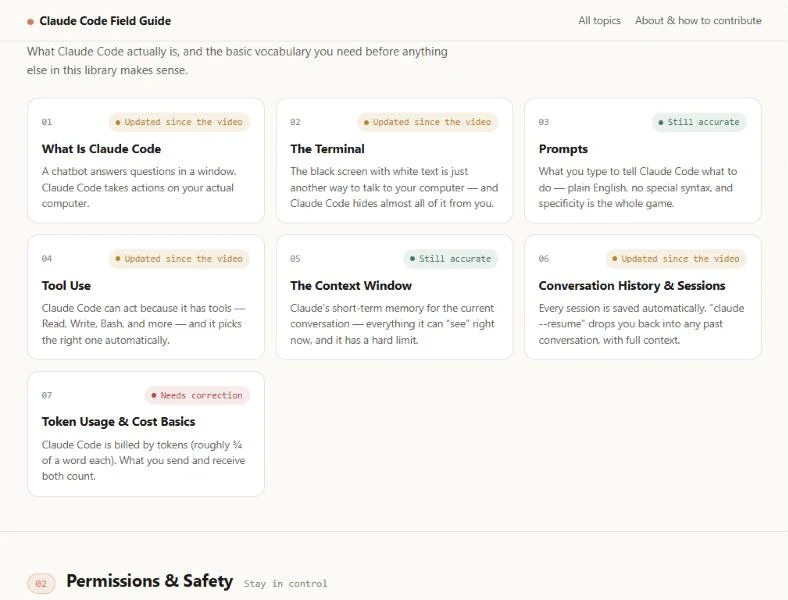
Claude suggested giving each topic a status: still accurate, updated since the video, or needs correction. The labels make the guide scannable, though they still need refining.
Key decision
One guide instead of several separate sites
The first version was a set of standalone pages, each in its own repository. I consolidated them into a single site. One guide gives a more complete view of Claude Code, and it's much easier to navigate than several separate websites.
It's also easier to keep current: the whole guide is plain HTML generated from one Python data file. Adding a topic or changing a status means editing one entry and running one script, which rebuilds every page, including the navigation.
What I found
Most of the video still holds, but 4 points would now mislead you
Only 7 of the 27 concepts were unchanged. 24 had been renamed, expanded or given new options. Four were wrong enough to cause real problems for someone following the video today:
| Topic | What the video said | What's true now |
|---|---|---|
| Token usage | Check usage with /cost and /stats | Both replaced by a single /usage command |
| Models and effort | Named specific model versions | Versions date quickly; a new effort-level control was added |
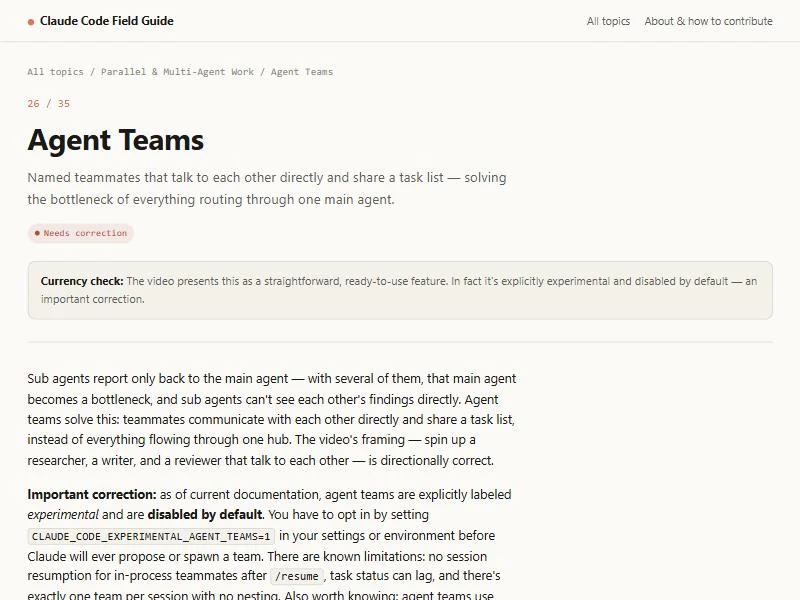
| Agent teams | A ready-to-use feature | Experimental, off by default, and about 7x the token use |
| Scheduled tasks | The "Ralph loop" as a separate plugin | Built in as /loop and Routines |
What readers get
A status on every topic, and the source behind it
Outcome
Useful from the first readers
So far I've shared it with a few colleagues, and they found it useful. Sharing it more widely on LinkedIn is the next step.
What's next
A living guide needs a pipeline, not good intentions
I'll be honest: I haven't kept up with the updates since September, and Claude Code keeps changing. That's exactly why my next project is to automate the upkeep. I'm weighing a workflow tool such as n8n for a pipeline that checks the documentation for changes and flags the topics that need a new status. Refining the status labels is part of that work.
What I learned
A link to an example isn't a specification
I've built several page collections with the same method, giving Claude links to my earlier projects as examples. Most of the time it understood what I needed. Once, though, it produced a completely new format and said it couldn't work out the exact page setup and formatting just from the link. That surprised me, because it hadn't been a problem on earlier projects.
The lesson matches what I learned on the exam portal: spell out the expected result instead of assuming the AI will infer it from a reference.