AI portfolio / Case study
Ten Word documents, one exam portal, a top grade
My sister had hundreds of pages of material and little time before Hungary's advanced civil service exam. She asked me to merge her documents. I ended up building her a searchable study portal with three versions of the material, and she earned the top grade on the written exam.
- Role
- Solo: product, prompting, quality checks
- User
- My sister, with a fixed exam date
- Built with
- ChatGPT, GitHub and Vercel
- Timeline
- Built late September 2026, rebuilt 8 October for new official material
- 10 → 1Word documents merged into one searchable portal
- 0of 4,661 paragraphs missing after the written merge was checked against the originals
- 532026 legal updates across 33 oral topics, kept in full and in red
- 5 / 5written exam grade, the top mark (4 / 5 on the oral)
Problem
Hundreds of pages, short prep time, no way to prioritize
The exam has a written and an oral part, each covering five modules from constitutional law to EU law. My sister had five Word documents for each part, hundreds of pages in total, with only a short time to prepare.
- No search across documents. She could only search the ten files one at a time.
- Hidden overlaps. Many topics overlapped, but there was no way to see where at a glance.
- No way to prioritize. Written questions are worth 15, 10 or 5 points, but they were spread across files by module. She couldn't put the most valuable questions first.
| Module | Subject | Written | Oral |
|---|---|---|---|
| I | Constitutional and public administration fundamentals | 60 | 19 |
| II | Legislation and applying the law | 74 | 20 |
| III | Public finance | 41 | 20 |
| IV | Organizing and leading public administration | 53 | 20 |
| V | EU institutions, operation and law | 74 | 20 |
The insight
She asked for one merged Word file. What she needed was to spend limited time where it earns the most points, with a fast way back to the full detail when she needed it.
So the scope grew in steps, each one answering a real study need: written questions sorted by point value, three depths of oral material, and finally a website that makes all of it searchable from her phone.
How it was built
Six rounds with ChatGPT, each one checked
-
Merge the written questions by point value
All 302 written questions, grouped 15 → 10 → 5 points, then by module, keeping the original Hungarian text and formatting. Word reported unreadable content in the first file. I asked for a check against the five originals, which found two lost images, one of them a decision-process flowchart. After the fix: 0 of 4,661 paragraphs missing, 14 of 14 tables, 234 pages.
-
Merge the oral topics
The five oral modules in order, with formatting, tables and diagrams intact: 6,046 paragraphs, 309 pages.
-
Find the right depth for the oral summary
The first summary came out at 35 pages: good for a last-day review, too thin to build an answer on. The second version gave each topic at most one page (100 pages). Then I realized I hadn't said the 2026 legal changes were critical. The third pass restored 53 updates across 33 topics, highlighted in red as in the official material, and still fitted one page per topic.
-
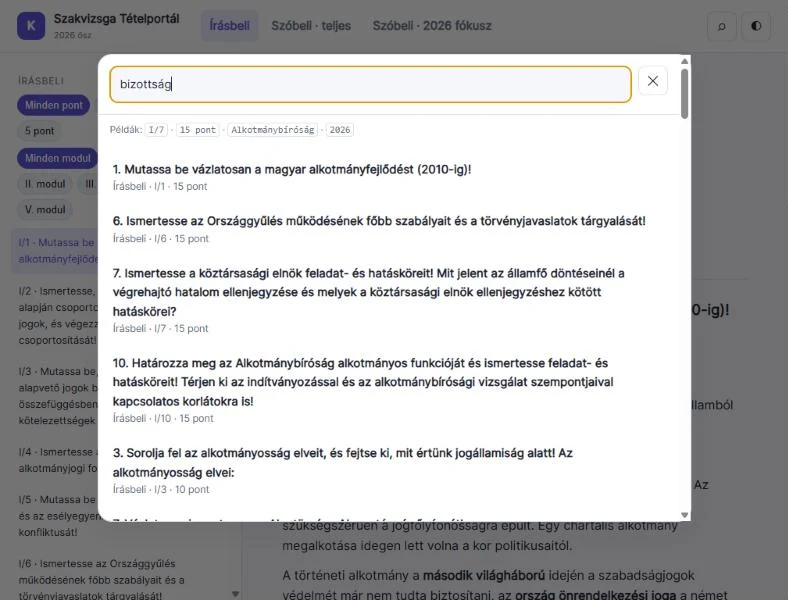
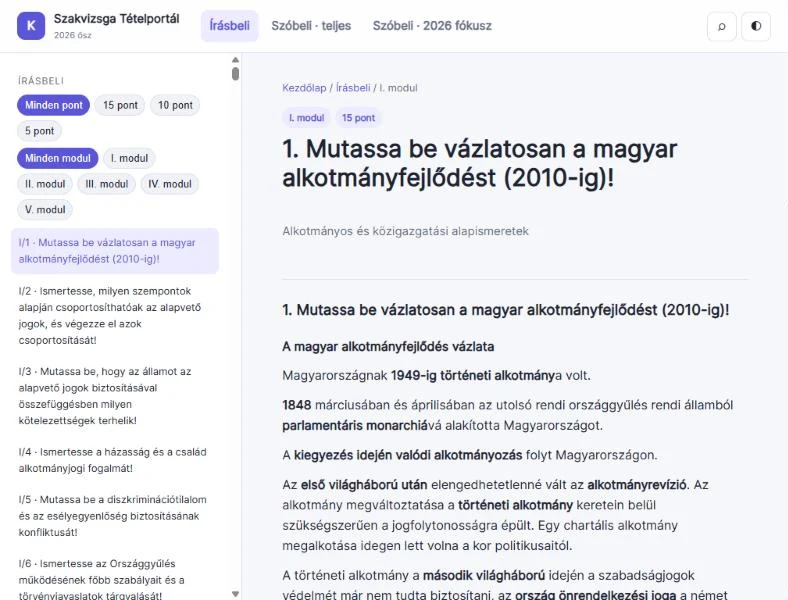
Turn it into a website
The first website package returned a 404 error on Vercel. Instead of debugging an unfamiliar setup, I pointed ChatGPT to the structure of my German learning portal, which already worked. The rebuild split the material into 500 topic files behind one search.
-
Condense the written questions too
234 pages down to 188. Higher-value questions kept more detail, lower-value ones were cut harder, and every 2026 change stayed in red.
-
Rebuild everything for new official material
On 8 October the exam body released updated answers. I had ChatGPT compare them with the live portal and rebuild every version. On the first attempt it skipped the condensed version and the checks, so I pushed back and had the whole package redone and validated before replacing the site.
What she got
One search box for everything, and a link for every topic
Key decision
A shorter version, but never at the cost of what will be examined
The 2026 focus version works like exam-ready study notes: short enough to study intensively, complete enough that she could go into the exam well prepared even if it was the only version she studied. After the 2026 elections in Hungary several laws changed, and those changes were likely to come up in the exam. So every 2026 change and every list stayed word for word, even where that made a topic longer. The full version stayed alongside it for checking details.
| Version | Topics | Words | What it's for |
|---|---|---|---|
| Written topics | 302 | 92,600 | Grouped by 15, 10 and 5 points, then by module |
| Oral topics, full | 99 | 96,800 | The complete official answers, for depth and checking |
| Oral topics, 2026 focus | 99 | 81,400 | A shorter study version that keeps every list and every 2026 change in full |
Accuracy
Legal material leaves no room for an AI that improvises
- Source only. Every request told ChatGPT to keep to the original text and add no outside knowledge.
- Checks against the originals. After each merge I asked for a comparison with the source files: paragraphs, tables, images and page rendering. That's how the two missing images were found.
- The source's own markings. 2026 changes were found by the red highlighting in the official documents, not just by searching for "2026", which would have missed some.
- A human in the loop. My sister checked the content as she studied it.
Outcome
Top grade on the written exam
My sister passed with a 5 on the written exam, the best possible grade on Hungary's 1 to 5 scale, and a 4 on the oral exam. Her oral topic was an exceptionally hard one, so she counted that as a win too.
What she valued most
- Ease of use. She loved how easy the site was to use.
- Mobile friendly. It worked well on her phone as well as on a computer.
- Dark and light mode. She found being able to switch between them extremely useful.
Phone use and the two modes were both in my original brief for the website, so the requirements I set up front turned out to be the features she valued most.
What I learned
Model choice and a clear brief mattered most
The first summaries were not encouraging: they lacked coherence and left out important information. I tried the same task with several models. For this Hungarian legal material, ChatGPT gave the best results, Claude was usable but not good enough for this job, and Gemini failed even on a Pro subscription.
Next time I would:
- Show an example of the output I want, such as one fully worked topic at the right depth.
- Give the complete brief up front, including priorities like the 2026 changes. Adding them later cost a full extra round.
- Define done in the first request, including which checks must pass, instead of asking for them after each result.
See it yourself
The interface is in Hungarian, because it was built for a Hungarian exam. Press Ctrl+K to search.