AI portfolio / Case study
A lighthearted app still meets people on their hardest days
I wanted to learn what it takes to build a complete product: accounts, guardrails, help for users, paid tiers and payments. I picked a tarot app because it seemed lighthearted. Building it showed me how much care even a "fun" product needs, so I put safety ahead of making money.
- Role
- Solo: product, requirements, testing
- Users
- Prototype; a private beta is planned
- Built with
- Lovable (TanStack Start, TypeScript, Lovable Cloud)
- Timeline
- 3 days of building, 23 to 25 September 2026
- 3days from first request to a working app with guardrails
- 78tarot cards, each with its own symbolic artwork
- 3crisis flows, for self-harm, abuse and immediate danger
- 28automated tests passing, safety checks included
The goal
Build a whole product, not just a demo
My earlier projects were guides and study tools. This time I wanted to go end to end: users who sign in, a product they come back to, limits, help when things go wrong, and eventually paid tiers. A tarot app gave me all of that in a small, contained scope.
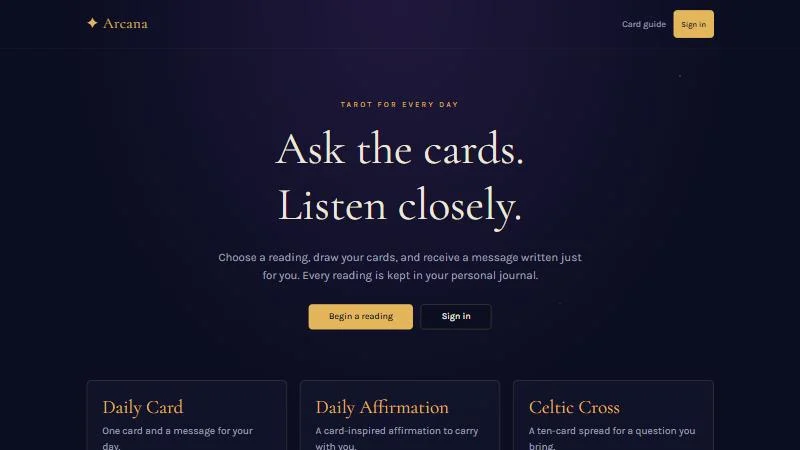
Users choose a daily card, a daily affirmation, or a ten-card Celtic Cross reading for a question they bring. An AI writes the message for each reading, and every reading is saved to a personal history they can search, print, export or delete.
The insight
People don't only bring curiosity to a tarot reading. Some bring fear, grief or danger, and an AI that answers them has to be ready for that.
That changed the order of the work. When Lovable proposed a monetization plan with prices, streaks and upgrade prompts, I paused before anything was built. First I asked about costs, legal obligations, hosting and how to stop the AI from producing harmful content.
How it was built
Three days, one conversation with Lovable
-
Day 1: the core product
Sign-in with email or Google, the three reading types, a searchable history, card meanings, data export, account deletion and password recovery. My first sign-up looked broken; the confirmation link opened a blank page, which I reported and had fixed.
-
Day 2: the deck and the rules
A unique, symbol-accurate design for all 78 cards, a true Celtic Cross layout, and full keyboard and screen-reader support. I also set the product rules: one daily card and one affirmation per day, and at most 10 saved Celtic Crosses, with a warning before the oldest is replaced and the option to print or save it first.
-
Day 3: print, legal pages, and safety before money
Print and PDF fixes, Privacy and Terms pages, then a researched monetization plan. Instead of building it, I asked for costs, legal points and guardrails first, and had the safety system built and tested.
Key decision
Guardrails first, payments later
I asked for clear limits: no harmful, offensive, sexual or 18+ content, nothing that could put a user in danger. The result checks every question before any cards are drawn, and every reading before it is saved:
- Before any cards are drawn, the question is checked. A harmful or sexual question gets a polite "let's ask that a different way" and doesn't use up the user's reading.
- If the question suggests a crisis, the user gets a caring support message with helplines instead of a reading: one version each for self-harm, abuse and immediate danger, with Hungarian and international numbers.
- The AI writes the reading under strict rules: no medical, legal or financial advice, and no predictions of death, illness or disaster. The Death card is read as change.
- Before the reading is saved, it is checked again, and anything unsafe is replaced with a gentle message about reflection.
- Blocked requests are logged without what people typed: only the type of problem and an anonymous code, for a private safety review.
Every reading also carries a note that it's for entertainment and reflection, not a substitute for medical, legal, financial or mental health advice.
What testing caught
Testing found real problems the AI had missed
Lovable often reported work as done before it had been checked in a browser. My own testing caught the first four problems below; the safety tests caught the fifth.
| What I found | Cause | Fix |
|---|---|---|
| The Death card showed an almost empty front | Artwork squeezed into a corner of the card | All 78 card fronts audited and redrawn at full size |
| Cards stopped loading and would not flip | A button wrapper shrank the artwork to icon size | Fixed, with automated tests to stop it coming back |
| Printed cards looked as if they were under deep water | A print rule turned all artwork dark | Crisp print colours on a pale, ink-saving blue page |
| Daily readings could be drawn again and again | No limit enforced | One per day, enforced on the server too |
| A threat from an ex was flagged as self-harm | Safety classifier mixed up two crisis types | Now shows the danger message, with the right helplines |
The safety tests ran 12 sample questions through the checks and 7 harder ones through the live AI, then three real questions on the site, signed in.
What's still open
Honest about the gaps
- Some helpline numbers were added from the AI's own knowledge and must be checked against official sources before any launch.
- Users should be told clearly that readings are written by AI, as the EU AI Act requires. The current note doesn't say so yet.
- The Privacy and Terms pages are placeholders the AI wrote; a lawyer needs to review them before anyone pays.
What's next
A complete product before a single real payment
I can only charge money once I have my own company, for legal and tax reasons. So my roadmap builds everything else first, in five phases with a gate after each: close the gaps above, add moderation and customer support, build the paid tiers with payments in test mode, run a private beta with usability tests, and add reminders and streaks with limits, so they invite rather than pressure. Going live is the last step, and the only one that waits for a company.
What I learned
The careful part is the product
Generating a working app took hours. Deciding what it should refuse, how it should respond to someone in distress, what it may store and when it may ask for money took most of the thought. An AI builder can propose a monetization plan in minutes; judging whether that's the right next step is still the product manager's job.
See it yourself
A prototype preview hosted by Lovable. Sign-up works, but this is not a public product.